Will there be WW3?

As far as geopolitics goes, today is a day of crazy (the Ukranian plane crash, the attacks on the US bases in Iraq, saber-rattling by the top leadership).

However, I believe that things will de-escalate soon. An actual war at this time does not serve any side of the conflict well. None of the players are stupid, as much as people like to think of Trump as an idiot. Iran is a nuclear power, and an all-out war with Iran will only benefit those who sit this one out, namely China, and perhaps Russia.

Islamic countries will make noises as usual, but when push comes to shove, none will side with Iran to face the US, except maybe the Iranian satellite states (the “Shia Crescent”), and grudgingly at that. However incompetent they may be in domestic politics, the American leadership is not crazy enough to think that ground invasion of a nuclear power is possible.

I think there won’t be a WW3. There is no reason to believe that if a war breaks out, it will take place on any theater beyond the Middle East. It would be better for all parties to work on de-escalation: stage bullshit attacks with no casualty, announce some sort of PR victory to save face, do the “Death to America” song-and-dance half-assedly for the home crowds, and open a backchannel to discuss ways to stop things from getting worse. And throw out some Dollars while you’re at it. Obama threw billions to Iran and there was no escalation during his presidency.

I am an optimist, but in case I am wrong, may Allah save all of us.

Keeping things simple

Yesterday, I was in a mall. I wanted to buy a bottle of perfume from a store. This is a chain store with many branches in Malaysia and in other countries.

I normally carry cash around (not much of an e-wallet guy), so I think of any retail transaction like buying a donut*: take item, go to cashier, pay cash, pocket the change, exit store. End of transaction.

But not this time. First, the saleslady asked me whether I have a certain e-wallet account, so I could be eligible for a 5% discount. I said no, cash please.

Then, she asked whether I would like to apply for membership.

I said no, not interested. I don’t shop there regularly anyway.

Then, she suggested that I download the chain store’s own mobile app — available on Android and iOS — and explained that by downloading the app, I can collect points, get exclusive offers, and redeem points by buying more stuff at any store nationwide. I will have access to a dashboard complete with bells and whistles, all at my fingertips, not to mention notifications of upcoming sales campaigns.

I said no.

She then asked if I wanted to buy a shopping bag. She phrased it in the most middle-class way possible: rather than buying a shopping bag, I would be “making a contribution in support of their no-shopping bag campaign”.

No. I can put it in my work bag. It’s a small bottle — just 100ml.

Then, almost exasperated with my refusal to do any other transaction except paying in cash, she made a final attempt to upsell by asking me for my birthdate (and my IC to verify it). So I could receive a special discount for my upcoming birthday.

I finally said no for the last time.

After what seemed to be an eternity in the upsell limbo, I paid for the purchase, pocketed the change, said thank you, and left.

Call me old-fashioned but if I step into a store, I just want to buy something, pay in cash and leave. Why is it so hard to do so nowadays?

*RIP Mitch Hedberg

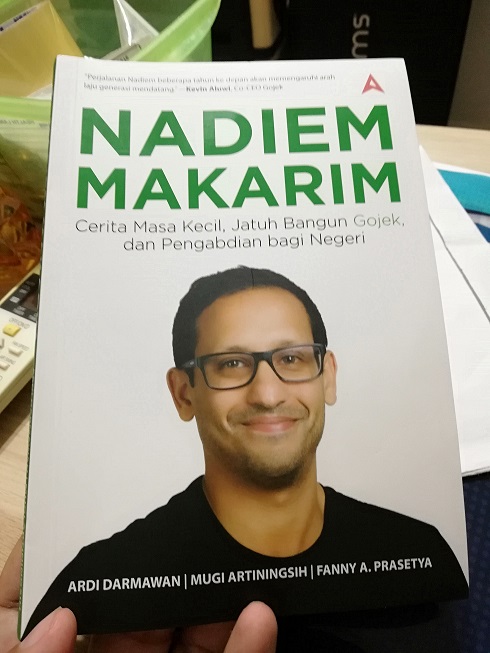
Reading “Nadiem Makarim”

Last Friday, Khairul (the CEO of Pandai.org) lent me a copy of “Nadiem Makarim”.

rbt

It is the authorized biography of the founder and former CEO of Gojek, the Indonesian startup unicorn, and currently the Mendikbud (Menteri Pendidikan dan Kebudayaan) of Indonesia.

Khairul told me it is not easy to read because it is written in BI. What’s the big deal, I said, I can read English quite well. It turned out that he meant Bahasa Indonesia. OK, I can still read Bahasa Indo, but I admit that some words I don’t understand so I have to guess what they mean. Safe to assume I understood 99.9% of the content.

Here are some takeaways:

  1. Privilege is the surest path to success, and early privilege is the best advantage that can be bestowed to a person. The world is unfair, and whether we like it or not, privilege matters. Nadiem had a privileged background (a grandfather who was part of the Indonesian independence movement, a father who was a distinguished lawyer, basically a wealthy and socially influential family). He went to the Dalton School in New York for secondary education and the United World College in Singapore for pre-university education. That leads, later, to an Ivy League university, then McKinsey, then Harvard MBA, the whole shebang. He was set up early for success. This was spelled out unapologetically in the first few chapters. Of course, a privileged upbringing is not sufficient for success in life, as the many people with similar pedigrees but much more modest achievements can attest. However, and this is my point I’d like to emphasize, more than intelligence and work ethics, the most discerning factor that determines success is the early advantage that comes from a privileged upbringing. Take note, parents.
  2. He is deeply patriotic. He spent most of his youth outside Indonesia but have never lost the deep desire to serve his homeland. He would’ve had a high flying career with any foreign company he cared to join, but he staked his early professional life on a fledgling startup whose objectives are to serve fellow Indonesians and make Indonesia a better place.
  3. Gojek started slow but grew fast. The company was on concierge mode for the first few years of its existence: Gojek employees would take calls at its call center from people who want to order ojek (motorcycle) to go somewhere. Gojek grew organically for the first 3 years, yet a huge part of Gojek success later can be attributed to their early days, where it is more a consumer-facing company than a technology company. Once they move on to the ridesharing app model, the exponential growth started, and within a few months, the number of drivers increased more than a hundredfold.
  4. Nadiem has extraordinary people skills. He is as comfortable dealing with Gojek drivers as he is with his Harvard classmates or the tech types or the Indonesian elites. Great choice as Minister whose mandate is to serve the public.
  5. He works hard for Gojek and would stop at nothing to ensure its success. In a later chapter, there is a story of how the Indonesian government once tried to shut down Gojek. Nadiem and his team did whatever they could and pulled all the string the could pull to keep Gojek from going down. Finally, he managed to secure a meeting with Presiden Jokowi, and made an impassionate plea to him, which resulted in the Ministry of Transport rescinding their earlier decision to ban Gojek.
  6. Sometimes, you need to watch from the sidelines. When Gojek operated in its early years, Nadiem was often away working at other companies (first at Rocket Internet, and then later at Kartuku). He was the CEO of Rocket Internet Indonesia, and while working there, he can only manage to work on Gojek part-time. Yet, the experience and perspectives he obtained outside the company helped him to steer Gojek to greater heights when he returned to work full-time at Gojek.
  7. Get creative types aboard. Gojek is the brainchild of Nadiem and two co-founders that he met at Harvard Business School (where he was also classmates with the two future founders of Grab). The three Harvard founders of Gojek have technical and business backgrounds. So, one of their earliest decisions was to bring in a fourth co-founder who has a design background. He came up with many of the Gojek brand identities which are still used until today. A good lesson for startups.

Verdict: A good read worth spending a couple of afternoons on. Candidly educational for startup founders like me. Though at times the writing feels too hagiographical.

Life planning using to-do lists

The most useful tool in my life management toolkit is my to-do list, which I write on a .txt file (keeping it simple!) and update daily.

Most people think about their lives as a series of short-/medium-/long-term plans. While it is sometimes necessary to take stock of the present and plan for the future, what is more important for me is breaking down the plans into actionable to-dos that I can act on today or within the next few days. More important, I believe, than life objectives, bucket lists, new year resolutions, and other “big picture” blueprints for how I should live my life.

Sometimes, I talk about my visions for the future, but I rarely plan for them directly. My approach is breaking them down into small steps, which are necessary to achieve the next step, which in turn will lead to the next step, which hopefully will lead me, step by step, towards the desired vision at the desired time in the future.

For example, I do not make a plan to “get into the blockchain industry by 2021”. (This is just an example, I do not actively seek to be in the blockchain business, sounds like too much hype for now).

This is how I will plan it: This coming Tuesday, I will spend 2 hours in the morning to

  • read 5 short articles about blockchain
  • watch 3 videos on blockchain
  • order or download 3 books about blockchain
  • shop for online classes or upcoming conferences/talks on blockchain technology.

After I do these, then I follow up with plans for the week after, e.g., reading one book on blockchain technology within 5 days. And so on.

If something seems too far ahead, I stop planning for it and just wait until the time comes. It makes living less burdensome; no need to keep track of so many things at once.

On the flip side, I like to plan every small thing that I have to do. An actual item on my to-do list: This Friday, after office hours, I will go to Mr. DIY to buy a small tube of elephant glue, and then go home and glue back a fridge magnet that had been broken in half by my son. It was his favorite fridge magnet, in the shape of a Friesian cow. The head of the cow is attached to the body with a small spring, so the head will bob if you give it a slight touch (toddlers dig that stuff). There is a duplicate one on the refrigerator of my office pantry, but I will not take that one home but instead fix the one I have at home. If I don’t plan to fix it, then it will remain unfixed for many months (most probably, forever).

The purpose of education is to develop complete human beings

In any education discourse, one should start with the basic question:

What is the purpose of education?

This fundamental question draws different answers from different people, depending on one’s worldview, upbringing, agenda, ideology or any combination thereof.

For example, an economist might view education as a tool for economic development. To them, the measure of the educational attainment of a country is closely related to the economic numbers, such as the GDP growth or productivity growth.

An industrialist, perhaps agreeing with the economist, would see education as a necessary process to supply the workforce.

A politician sees education as a propaganda tool. Was it Che Guevara or someone else who said that — and I am paraphrasing — give me the education of the youths, and I will capture the whole country?

The way we view the world affects the way we see education, and how we answer the fundamental question above. Furthermore, this worldview will impact how we think of how the education system should be.

A tech worker would push for more hard skills and digital competencies to be taught at the school level, while someone with a civil service background would prefer more emphasis on civic studies and nationhood in the curriculum.

All of these views are valid.

Our society is made of people from different backgrounds, all coming together to build a nation. A police officer, a wildlife conservationist, a computer programmer, a politician, and a gamelan performer, all have stakes in the nation-building agenda.

The purpose of education is to serve everyone in society.

The purpose of education is not just to impart literacy and numeracy, or to create the future workforce; it is to develop people into complete human beings. Human beings with different physical, social, intellectual, spiritual, economic and psychological needs. Human beings whose choice of life to live is practically unlimited. Imagine two diametrically opposite members of society. For example, imagine a rice farmer who spent his whole life toiling in the paddy fields, and a corporate head honcho working in her C-suite office in the Golden Triangle.

Education should serve them both, and everyone else.

What does it mean to be a complete human being? A complete human being, at a minimum, should be a good citizen, a good neighbor, a good member of society and a productive member of the workforce.

So how to educate people towards this goal, as their needs are different? We cannot cater to every student individually with tailor-made education, unless a student comes from a rich family and can afford personal tutors, like the princes of European royal houses in the 18th century. The rest of us have to go to school. The school has a system, which is supposed to approximate the ideal education system to develop complete human beings.

Students should be taught Language (which includes the classical trivium of grammar, logic, and rhetoric). Mathematics and Science, to prepare them for economic and scientific activities in the modern world. Literature, History, Geography — to learn about the world around us through different prisms. Home Economics and Commerce to function as human beings. Moral or Religious Studies to develop positive values. Civics to learn how society — and the institutions that govern it — function. These are basic subjects that all students around the world learn at school.

In other words, the subjects we already have in school is a close approximation to the ideal education system. That is why people have been teaching the exact same subjects for centuries.

I never really buy the argument that the choices of subjects are obsolete, that this type of education system was designed during the industrial revolution to cater to the employment needs at the time (factory workers need literature and geography?).

No, even back then the education system was created to approximate the ideal education system, which purpose (I believe) is to develop complete human beings. It was not created mainly to churn out uncritical people so they can be put on the assembly line. This is somewhat of a modern education meme, but its veracity is not supported by historical facts (as a matter of fact, classical education thrived the most during the Industrial Revolution).

There’s a reason why schools the world over teach roughly the same set of subjects at the primary and secondary levels. It has been proven to work. It has created the modern world as it is. It is a close approximation of the ideal education system which caters to members of society with different needs.

And I am suspicious of any effort to radically change the curriculum away from the existing system and into a “modern” curriculum with an emphasis on technology. Either these efforts are driven by Big Tech (who wants to sell “education solutions” to schools and parents), or driven by misguided tech cheerleaders who know very little about the actual education system, but want to force their worldview on the education system using tech buzzwords like IR4.0 and Digital Economy. Alain de Botton called this type of thinking boosterism.

Let us get back to basics, leave the good parts of education alone, tweak the ones that do not work, and let us not radically change the system under the banner of technological boosterism.

The purpose of education is to develop complete human beings, not automatons.

Judging a book by its cover

“Don’t judge a book by its cover” is nonsense.

Book cover design is a billion-dollar industry. The cover of a book (including the front cover, the back cover, and the dust jacket) contains the title and subtitle of the book, the name of the author(s), their bios, blurbs, recommendations, retail price, i.e., most of the things you need to know in order to decide whether to buy a book. So we can make a decision even if the book is shrink-wrapped (I am looking at you, Kinokuniya).

Same in life. We often make decisions by looking at the surface. Imperfect, but damn efficient.

Let’s take the adage literally. Last week I went to a bookstore in Subang Parade. On the nonfiction shelf, I saw a book by Michael Chabon. I know him as a novelist (with a Fiction Pulitzer under his belt), but this is a non-fiction book.

Once I saw Michael Chabon on the cover, I need not check anything else. I immediately picked it up.

(The book is titled Pops, by the way, and it is about parenthood.)

Why the snap decision? Chabon is perhaps the greatest contemporary novelist that I have ever read. I read The Amazing Adventures of Kavalier & Clay in college, which blew my mind, and I felt a bit sad when I got to the end. I have also read his other novels Wonder BoysThe Yiddish Policemen’s Union, and Telegraph Avenue, which, though not as celebrated as Kavalier & Clay, were masterfully written.

So anything by Chabon, I believe I can’t go wrong with.

(It was an ok book. The first chapter is my favorite. It is about his conversation, during a literary party many years ago, with an older writer whom he looked up to. The older writer warned Chabon against getting married and having children, and said that by having one kid, Chabon will miss out on writing one book in his lifetime. Chabon now has four kids and he mused about the hypothetical four books that supposedly never got written. Chabon concluded that he need not pay any attention to these literary stillborns; his 14 books and numerous literary awards attest to his ability to balance his writing career with family life.)

Similarly, I judge films and TV shows on Netflix by their “covers”. I don’t read in-depth reviews before deciding to watch something or not. A cursory glance at the synopsis and the list of actors/directors/showrunners often suffices to find good films and TV shows.

There were misses at times, for sure. The Irishman, starring the big-screen Mafia triumvirate Joe Pesci, Robert DeNiro, and Al Pacino, is too much of a slow burn. The Kominsky Method, though featuring two legendary actors Michael Douglas and Alan Arkin, didn’t do it for me, and I never went beyond the pilot episode. But most times, looking at the cover is enough.

In social interaction, the first impression is often the most important impression we have of someone. If it is underwhelming, there might not even be a chance for a second impression.

So, judge away. And conversely, put on a good cover if you want to be read.

This is another example of signaling I wrote about in the previous entry.

Signaling is Important

One day, I scheduled a meeting with a lady. It was a casual business meeting so we decided to meet in a cafe, instead of an office. I have never met her before, but we talked on the phone once.

She arrived at the cafe 15 minutes late, with Starbucks cup in hand (the cafe we’re in was not Starbucks), and immediately offered an apology: “Sorry I’m late Suhaimi, I had to drop my daughter off at piano class in TTDI, a bit of traffic on the way here.”

I met her for 10 seconds, and already I picked up several signals:

  • That she is at least middle class (Starbucks takeaway even though we were meeting at another cafe);
  • That she lives in a middle-class neighborhood (the kind of neighborhood where parents send their kids to music class. Perhaps one of the neighborhoods in or around TTDI);
  • That her family is well-off (dropping her daughter in the afternoon means she does not have to keep a 9 to 5 job). Perhaps a high-income spouse, or inheritance, or both;

These are signals. Signals are not perfect. It could be the case, for example, that she used an empty Starbucks cup to fill in Ribena, her favorite beverage; or that she lives in a PPR flat; or that the piano class is free of charge, or really cheap; or that she actually worked desk office job, but that was her day off. But then again, probably not.

The signals were too strong, and Occam’s razor presumes that my initial assumptions were all right on the spot.

(Not to mention the signals I picked up from her middle-class demeanor. I recognize a certain poise common to well-to-do middle-class ladies, even when they dress casually, that cannot be faked by the working class.)

The signals being what they were, it made my job easy. I dealt with her accordingly as I would a middle-class person (even made a correct guess on where she went to school), and the meeting went well, and we both got what we wanted from the meeting.

She did not go out of her way to tell me she’s middle class, but everything around her gave that signal. Signals I was too ready to pick up.

We deal with signals every day. We give out signals, and picked them up, in our daily lives. Signals can be subtle or not so subtle. Signals galore on Instagram and other social media. People can be coy about it, but by sharing their lives online they are really signaling their lifestyle to you, along with their expectation of how you should respond to their show of lifestyle.

Some ways we intentionally or unintentionally signal:

  • Namedropping. The name of VVIP you know or have met, the events you attended, the school you went to, the companies you worked at. If you mention these in a conversation with the intention of impressing the others, even slightly, then it is a form of signaling.
  • Using “otherness” as a proxy for good. “This supplement is imported from France and approved by the European Homeopathy Association” (not everything that came out of Europe is a Peugeot or a Volvo. Europe is a huge landmass — some parts are shitholes, even in the developed countries). “Our international school has 80% expatriate teachers” (some of the worst teachers I’ve ever met are these “expats”). Another similar trick is to show oldness. “Established since 1833” — the signal being that the business is good, otherwise it won’t be open this long.
  • Stereotypes. All stereotypes — racial, class, profession, religious — are forms of signaling. Stereotypes exist for a reason, and though it feels good to be “woke” and judge every human as unique individuals, our biological instinct causes us to treat people as stereotypical members of their groups. Our brains have evolved to be able to make statistical calculations whether bad things are likely to happen, based on the existing information, i.e., the stereotypes.

I am perhaps guilty of using signaling more than most people, seeing that I made a living on a hustle, or, in a more respectable term, on pitching businesses to my clients. I know some of the psychological sales tricks, to appear humble and shy and subdued, and to project signals to clients, rather than saying things outright. Talking straight is sometimes a virtue, but at other times, the situation calls for the opposite: niceties, beating around the bush, unspoken innuendos. In that situation, don’t just say it, signal it.

Where is my flying car?

Wow, so today is really 2020.

I cannot believe this. My sense of time is warped up. I still remember clearly what I did on 1st January 2000. I was painting the side door of my parents house. I was 18 at the time, the paint was brown and I can still remember the smell of the fresh paintjob.

That was two decades ago.

2020 is supposed to be the year when we arrive at some sort of techno-utopia, or at least in the Malaysian version of futurology, the year of us joining the ranks of developed countries. We are not there yet. But, to be frank, I couldn’t care less.

We don’t need flying cars. Spare me the smart refrigerators, robot maids and instant delivery drones. We don’t need more automation. Is life all about maximizing efficiency? What’s next? A robo-AI data-driven smart machine to decide how much Vitamin D that I should ingest a day to the nearest 0.1 micrograms, and nanorobots to deliver them into my esophagus? Where does it all stop? Do we really need 10 thousand TV shows and films and 100 million songs at our fingertips? Can we do without being bombarded by commercials every 5 minutes of our waking hours? No, can’t do. It would be boring.

While we’re at it, why not play advertisement to fetuses? People already play Mozart to babies in the womb, why not go a step ahead and play ads instead to prep them to be future little consumers? Teach the unborn that Coke will “Refresh your Spirit” and make them “Feel the Moment”. That’s a startup idea.

Repeat after me:

  • the more technology the better,
  • the internet is supposed to be in all things,
  • everything needs to be upgraded,
  • everything around us is a startup idea,
  • and to be a consumer is the ultimate purpose of life.

Let Big Tech run the world, they will make it paradise on Earth.

For 2020, my wishes are for the world to be less ridiculous, for people to stop optimizing things that do not need to be optimized, for people to just sit down and take a breath and unplug and relax, for people to love others more and judge others less, for people to not have fear of missing out, and for people to discover, once again, how to be damn human beings.

Happy new year.

A look back at 2019

2019 was an interesting year.

Too many things happened, no need to bore you with the details of my personal and professional life.

But one event I cannot but recall.

My personal 9/11.

My mother passed away on 11 September 2019, after a very brief illness. It was the worst day of my life. Losing your mother at any age is not something you get over easily.

I took solace in the fact that all her family members were present at her deathbed (including my wife who got leave from her overseas military mission), that her illness was brief (she did not suffer for long — she collapsed one evening, and passed on the next day) and that nothing but good things were said about her after her death.

I still miss her every single day, but life goes on.

If your mother is still alive: call her, tell her you love her, ask her what she wants (and get it for her) and ask for her forgiveness. Do these regularly.

There will come a day when you won’t be able to.

The Pandai App Story: Part III

I’m in the mood for nostalgia.

Let me take a break from the story of the Pandai idea (which will resume in Part IV) with a personal reminiscence.

Warning: This is a lengthy write-up. There is a point to all this, which I will mention at the end. This is written exclusively from my point of view. This is my own personal answer to “Why Pandai?”. This write-up does not represent the perspectives of my co-founders, who have interesting stories of their own.


The evolution of an idea: A personal story

Let me take you back 22 years ago.

In 1998, I was a student at MRSM Jasin, Melaka (now known as MRSM Tun Ghafar Baba, after the former Deputy Prime Minister who passed away in 2006).

Khairul and Akmal, my future business partners at Aidan and Pandai, were my batchmates at MRSM Jasin.

MRSM Jasin back then was (and still is) one of the top schools in Malaysia in terms of academic performance. Back then, the school had perhaps the finest collection of high school teachers than could be assembled this part of the world, and I only exaggerate slightly. I love my teachers at MRSM Jasin. The teachers during my time showed such compassion and force of character. My two years in the school molded me all the way to adulthood. Until today I regularly visit my teachers (I make it a point to visit MRSM Jasin once a year) and I try to make them understand how grateful I am for my experience there.

The only issue I might have had was that it was a single-race school, so I did not have much interaction with non-Malay students.

In 1998, while in Form 4, I was selected to represent MRSM Jasin in a national mathematics contest, called the Olimpiad Matematik Kebangsaan, or OMK. OMK is the oldest and most prestigious math contest in Malaysia, and I wasn’t prepared for it when my name was submitted by my teacher. I believed that I have a slightly above average proficiency in school mathematics, but OMK was a totally new ballgame. Since this was a national-level contest, the OMK problems were designed to be beyond the normal curriculum, and solving them requires a healthy dose of creativity, rigor, and problem-solving ability.

Let me make a long story short, and fast forward from here so I can get to the point.

A few weeks later, I was announced as a winner of the OMK. I placed 2nd nationally, although I got a perfect score (the first place was won by Ong Shien Jin, who also got a perfect score, and who later went on to study at MIT and Harvard, and who remains a good friend until today).

After I won the OMK, I was invited to train with the national math team — who knew such a thing existed? — for a shot at representing Malaysia internationally. That was when I first heard about the International Mathematical Olympiad, or IMO, the prestigious annual math contest that was founded in 1959, and is the de facto “Olympics” of competitive mathematics. The IMO is a contest for pre-university students, and each country can only send 6 participants to the contest that takes place every summer in different cities.

I made the IMO team in 1999, 2000, and 2001. If I remember correctly — memory a bit hazy nowadays — I went to Bucharest (Romania), Taejon (Korea), and Washington DC (USA) for these IMOs. I was coached by Prof. Abu Osman, a brilliant mathematician who is a demanding taskmaster yet, at times, a kindly father figure to me.

My involvement in IMO eased my transition somewhat into tertiary education. I received scholarship offers as well as offers from various universities in the US. I decided on MIT and to major in mathematics. I enrolled in the fall of 2001 and received my scroll four years later.

After I graduated from MIT, I decided to reject all job interview calls and promptly returned to KL, so I can spend time with my parents from whom I have been away for four years. I spent my days at home writing a manuscript, a kind of problem-solving guide for students who are into competitive mathematics. After being jobless for 6 months and feeling kinda bored working on my personal project and playing GTA: Vice City every single day, I decided to take a job at Khazanah. But my real passion was still mathematics education.

I left Khazanah after a year to focus on mathematics education. I started off small, conducting math programs here and there under the ArdentEdu brand. I taught tuition classes. I took up any invitation to give a talk or conduct a workshop on mathematics. Basically, anything to keep afloat (I didn’t have any savings at this point).

However, the big break came soon. In 2007, ArdentEdu was approached by a state government to conduct a statewide STEM development program, focusing on top schools and top students in the state. We quickly assembled a team and closed a deal worth half a million RM with the state government. This was a princely sum of money back then. I was 25 years old, just started a new company, with a tiny office (more like broom closet), with no savings at all. To close a deal this size was nothing short of divine intervention. I stopped double-guessing my decision to resign from my corporate job and jumped headlong to pursue my true calling.

At the same time, I was heavily involved with the IMO. Since I was one of the few former IMO participants from Malaysia with a math degree, I was appointed by the Ministry of Education to be the head coach of the Malaysian IMO team, the position I held until very recently. I went to all IMOs from 2007 to 2015, and that brought me close to the international competitive mathematics community.

There are two major math competitions in the world: IMO and Kangaroo Math. Both are different in focus. IMO is the “Olympics”, meant for the elite math kids, who are going to study at the top math departments in the world and become future beautiful minds. IMO is extremely competitive; only 6 students from each country are allowed to participate in it. On the other hand, if IMO is the Olympics, then the Kangaroo is more like “Hari Sukan Negara.” It is an open-for-all, come-in-the-gate-is-open type of mathematics event. The objective is not really to find champion mathletes but to encourage students at all levels to love mathematics more. IMO involves about 600 students a year, but Kangaroo participants number about 6 million a year. IMO for the geniuses, Kangaroo for the masses.

I was (and still is) deeply involved in both IMO and Kangaroo, in IMO as a national team coach and in Kangaroo as the national director. Through my participation in both contests, I became active in the international mathematics education community. From my interactions with mathematical educators from around the world, I got to learn about mathematics curricula and standards in other countries.

I also became active in other international organizations that deal with math education such as the NCTM (National Council of Teachers of Mathematics, a US-based organization serving US math teachers, but whose annual conference is a huge event attracting 10,000 participants), ICMI (International Commission on Mathematical Instruction), WFNMC (World Federation of National Mathematics Competitions, of which I am the current rep for Asia), and others.


What is the point of telling you all this?

The point is: I do not dabble.

I don’t do dabble.

Whatever my professional activity is, it is not dabbling. I only dabble in hobbies, like collecting postcards and doing NYT crossword puzzles (both of which are my actual hobbies, by the way). But not in my work. Work is destiny. You only live once — so work is a serious matter.

Pandai is an idea whose root was planted 22 years ago. It is more than an interest of mine. It is my lifelong passion and my professional destiny. I have spent almost my whole adult life thinking and contemplating and working on mathematics education. In this field, I consider myself a lifelong learner and a perpetual rank amateur.

The Pandai idea is a natural progression of the lifelong passion I have of mathematics education. Simply put, my whole professional schtick is all about making people love mathematics more. And to make learning mathematics sucks less.

(By extension, my interest in mathematics education also coincides with that of science education, both of which can be thought of to be under the umbrella of STEM education, which, in turn, is under the bigger and more inclusive umbrella of school-level education.)

So, that is why we decided to work on education technology with Pandai. It comes from a lifelong passion.

When I say, “I am passionate about education,” I genuinely mean it, and I am not merely engaging in cliché.

I did not just decide one day to resign from my day job to write an app. Anyone can write an app. Pandai is not an accidental idea. It is a logical culmination of my work at ArdentEdu for the past 13 years, as well as my work in the mathematical education community, which I consider my professional raison d’etre.

I am going to work hard on Pandai.